Virtual Try-On: The Complete 2026 Guide for Fashion Brands

Virtual try-on was the single biggest growth category in fashion tech across 2024 and 2025, and by 2026 it has split into two very different products — self-serve widgets that shoppers use on product pages, and agency-delivered on-model imagery that replaces traditional studio shoots. This guide walks through what virtual try-on actually means in 2026, where it drives revenue, and which flavour your brand should be buying.
What virtual try-on actually means in 2026
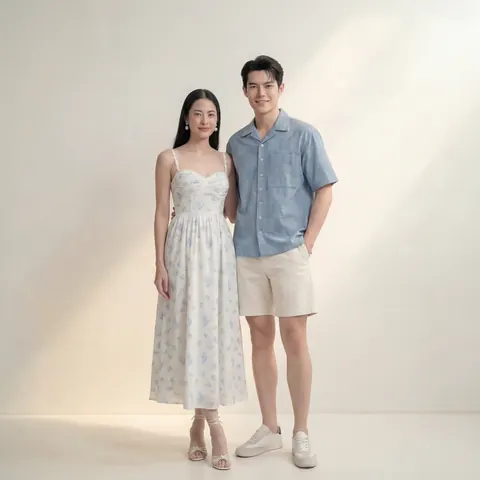
Virtual try-on is the use of AI to show a garment on a model or a shopper before that garment is physically worn. There are two dominant flavours in 2026. The first is consumer-facing try-on — a widget on a product detail page that lets a shopper upload a photo of themselves and see the garment on their own body. The second is brand-facing try-on — AI that puts a new garment onto an on-brand model so the brand can ship PDP, lookbook and campaign imagery without a studio shoot.
The confusion in the category comes from both products being called virtual try-on when they solve completely different problems. Consumer try-on optimises conversion and return rates on product pages. Brand-facing try-on replaces the production photoshoot entirely. AI Studio sits squarely in the second category — we are not a shopper widget, we are the agency that generates the on-model imagery your PDP and campaign need.
Why virtual try-on is the highest-ROI AI investment in fashion
Consumer try-on widgets from vendors like Fashn and Botika have been shown to lift conversion by 15-30% on product pages where shoppers engage with them, and reduce returns by 8-15% in apparel categories where fit uncertainty is the primary return driver. That is substantial revenue, especially for DTC brands operating on thin margins.
Brand-facing virtual try-on — what AI Studio does — has a different but equally compelling ROI. Replacing a $15,000 studio shoot with a $2,000 AI production that delivers twice the asset volume in a fraction of the time means the content budget stretches 7-10x further. Most of our enterprise clients have cut their monthly photography spend by 60-80% while increasing published asset volume by 5-10x.
Virtual try-on technology — what's under the hood
The engines driving virtual try-on in 2026 are all variants of diffusion models — Stable Diffusion, SDXL, Flux, plus fashion-specific foundation models from teams at Fashn, Botika and others. The technical challenge is garment warping — making a flat garment image drape correctly on a 3D body, respecting fabric physics, lighting, and occlusion (which arm goes in front of which torso).
In 2022-2023 this was the hard problem. In 2026 it is largely solved for structured garments (shirts, dresses, tailored pieces) and increasingly solved for soft drape (scarves, layered outfits, complex ruching). The gap between an engine output and a shippable image is shrinking every quarter.
Do you need a tool, an agency, or both?
If your priority is PDP conversion rate and you have a high-volume ecommerce store, buy a consumer try-on widget. Fashn and Botika are the leading options. Expect to spend $200-$2000 per month depending on traffic.
If your priority is reducing photography spend and shipping more on-model imagery, hire an AI fashion agency like ours. Done-for-you photography at 48-hour turnaround is structurally cheaper than owning an in-house production team.
Most mature brands in 2026 do both. A consumer widget for the storefront and an agency for the content engine.
What to look for in a virtual try-on partner
Quality bar: ask for before/after samples and insist the output be indistinguishable from a real photograph. Many vendors still ship AI-looking output with waxy skin or melted garment details. If you can tell it is AI, your customer can tell.
Model consistency: for brand-facing work, confirm the vendor can maintain the same model face across a full shoot. Consistency across 30 SKUs from one model is table stakes; vendors that cannot deliver this are not production-ready.
Commercial rights: worldwide perpetual usage should be included. If rights are plan-gated or geographically restricted, walk away.